CNC Machining Glossary: The Terms Every Shop Uses
Every trade has its own shorthand, and machining is denser than most. This glossary collects the terms that actually come up on a CNC shop floor, grouped by topic rather than dumped in one long A–Z list, and written in plain language you can act on.
It is a reference, not a tutorial: each entry links to more detail where the site already covers it. If you want the full process from design file to finished part before diving into terms, start with our guide to what CNC machining is and how it works. If a term below doesn’t answer your question, the acronyms and code tables at the end are the fastest way to decode a program or a spec sheet.
The process and the part
CNC (Computer Numerical Control) — the automated control of a machine tool from programmed instructions (usually G-code) instead of a machinist's hands.
NC (Numerical Control) — the tape-driven predecessor of CNC from the 1940s–60s; "CNC" simply adds the computer to NC.
Subtractive manufacturing — making a part by cutting material away from a solid block, the opposite of additive processes such as 3D printing.
Stock / billet / blank — the raw material a part is machined from: bar, plate, forging, casting or extrusion.
Workpiece — the piece being machined at any given moment.
Feature — a named geometric element on a part: a hole, pocket, slot, thread, boss or face.
Machinability — how readily a material cuts. Aluminium is high; work-hardening alloys such as titanium and nickel are low. Low machinability means slower speeds, faster tool wear and a bigger cost driver.
Material removal rate (MRR) — the volume of metal removed per unit of time; the product of depth of cut, width of cut and feed rate. Roughing chases MRR, finishing chases accuracy.
Chip — the slice of material a cutting edge removes. Chip shape, size and colour are the fastest diagnostics on the floor: a machine cutting wrong usually announces it in its chips before anything breaks.
Swarf — the collective waste of machining: chips and fine filings (especially from grinding). Swarf management means keeping it out of the machine, the coolant and the operator.
Burr — the thin raised edge a cutter leaves along a part edge. Burrs are removed by deburring (hand, tumbling, brushes or electrochemical) — rarely specified, almost always expected.
Built-up edge (BUE) — workpiece material that welds itself to the cutting edge at low cutting speed or temperature, degrading surface finish. The usual fixes are more speed, better coolant or a coated tool.
Coolant / cutting fluid — liquid or mist applied at the cut to control heat and flush chips. Flood, mist and high-pressure-through-tool are the common delivery modes.
Dry machining — cutting without coolant. Common for cast iron and some aluminium alloys; avoids coolant cost, mess and disposal, but demands tooling and speeds that cope with the heat.
Machines: types, components, axes
Machining centre — a CNC mill with an automatic tool changer and an enclosed cutting zone. The vertical (VMC) and horizontal (HMC) machining centres are the workhorses of most shops.
VMC (vertical machining centre) — spindle axis vertical, work on a flat table. The most common layout; easiest to load and to see.
HMC (horizontal machining centre) — spindle axis horizontal. Chips fall clear and pallet/tombstone work is natural, so it suits high-mix and unattended running.
Lathe / turning centre — a machine that rotates the workpiece against a stationary cutting tool to produce round, axially symmetric parts: shafts, bushings, bosses.
Mill-turn — a lathe with live tooling that can also mill, drill and tap, completing complex round parts in one setup instead of two machines.
Swiss-type lathe — a sliding-headstock lathe that feeds bar stock through a guide bushing. The design gives long, slender, precise parts in one pass — the default for medical, watch and electronics components.
CNC router — an open-frame machine with a high-speed spindle, built for soft materials: wood, plastic, composites and light aluminium. Not built for heavy metal removal.
EDM (electrical discharge machining) — removing conductive metal with controlled electrical sparks in a dielectric fluid. The route to hardened steel, sharp internal corners and fine detail that milling can't reach. Wire EDM cuts with a thin wire electrode.
Grinder — a machine that removes tiny amounts of material with an abrasive wheel; the path to the tightest tolerances and best finishes.
Spindle — the motor-driven shaft that rotates the cutting tool on a mill or the workpiece on a lathe. Spindle speed range and torque are first-order machine selection numbers.
Axis — a controlled direction of motion. Linear axes are X, Y and Z; rotary axes are A, B and C (rotation around X, Y and Z respectively). "A 3-axis machine" means three linear axes; 4- and 5-axis machines add rotary axes.
3 / 4 / 5-axis machining — a count of the controlled axes available. 3-axis cuts most 2.5D work (flat features, pockets, drilled holes). 5-axis lets the tool reach the part from more angles, cutting complex shapes in fewer setups — at the cost of more programming and a bigger investment.
3+2 (positional) machining — rotating the part to a fixed angle with the rotary axes, then cutting with the three linear axes. It gets most of five-axis flexibility for angled features without full simultaneous five-axis programming.
Simultaneous 5-axis machining — moving all five axes together to follow freeform surfaces: turbine blades, implants, moulds. Heavier CAM and verification demands than 3+2 work.
Trunnion — a tilting rotary table that adds the rotary axes to a 3-axis mill, the most common way machines become "5-axis."
Automatic tool changer (ATC) — the mechanism (with its tool magazine) that swaps tools into the spindle automatically. An ATC is what turns a CNC mill into a machining centre.
Turret — the indexable tool station on a lathe that rotates the required tool into cutting position.
Headstock — the lathe housing that holds the spindle, the chuck and the main drive.
Tailstock — the lathe unit opposite the headstock that supports the free end of long workpieces, or holds a live centre or drill.
Chuck — the workholding on a lathe that grips the part. Three-jaw scroll chucks are the generalist; collet and power chucks add concentricity, speed or both.
Collet — a split sleeve that grips a round shank or bar with high accuracy and concentricity, closing onto it as it is tightened.
Ballscrew — the low-friction screw-and-nut drive that turns motor rotation into precise linear axis motion. Preload and wear here directly set positioning accuracy.
Guideways — the bearing surfaces an axis slides on. Boxways are stiff for heavy cutting; linear rails are fast and precise for light, quick work.
Pallet — a removable workholding plate that lets one job be set up off the machine while the spindle keeps cutting another.
Interpolation — coordinating two or more axes so the tool follows a defined path: a straight line, an arc or a spline. Linear, circular and helical interpolation are the everyday forms.
Rapid traverse — the machine's fastest positioning move, made without cutting. Rapids get the tool between features; they are never a cutting move.
Dwell (G04) — a programmed pause, often to let a spindle reach speed or a surface clean up before the next move.
Feed hold — the control button that pauses axis motion mid-cut while the spindle keeps turning; the operator's first move when something looks wrong.
Part zero / work offset — the coordinate origin the program is written from, taught to the machine as a work offset (G54–G59) so the controller knows where the part actually sits. Getting part zero right is the difference between a good setup and a crash.
Programming, CAD and CAM
CAD — computer-aided design: software that models the part in 2D or 3D. The machining story starts here, but CAD alone doesn't cut anything.
CAM — computer-aided manufacturing: software that turns the CAD model into toolpaths, cutting tools and parameters, and then drives code generation.
G-code — the coordinate language of CNC: G00 rapid, G01 linear feed, G02/G03 arcs. It tells the machine where and how to move.
M-code — machine-function commands alongside G-code: spindle on/off, coolant, tool change, program stop (M03, M08, M06, M30…).
Part program — the complete sequence of code lines for one job: the file that runs the machine.
Block — a single line of a part program, usually one motion or function.
Postprocessor — software that converts generic CAM toolpaths into the G-code dialect of one specific machine and control. Using the wrong postprocessor is a classic way to get a machine moving the wrong way.
Modal — describing a code that stays active until changed or cancelled (most G-codes are modal). A modal G01 means every subsequent motion is a feed move until another motion code appears.
Absolute vs incremental — absolute programming (G90) measures every position from part zero; incremental (G91) measures from the current position. Absolute is easier to read and to recover from a mistake.
Canned cycle — a pre-packaged routine (drilling, tapping, boring) triggered by one G-code with a few parameters, instead of hand-writing every retract and feed.
Cutter compensation — the control adjusting the programmed path for the tool's real radius (G41/G42), so a reground or slightly different cutter still makes the correct size part.
Tool length offset — the stored length of each tool that makes the control treat every tool tip as the same distance from part zero; offsets are what let you switch tools without re-teaching zero.
MDI (manual data input) — typing a line or two of code directly at the control, to jog a move or test a function without running a full program.
Simulation / backplot — running the toolpath in software to catch crashes, gouges and missed features before the machine does it for real.
Dry run / prove-out — running a program on the real machine without cutting material, to confirm the setup, the zero and the code before the first chip.
G-code quick reference
G-code meanings vary between controls — especially turning cycles — so treat this table as the near-universal core and confirm anything unusual against the machine manual.
| Code | What it does |
|---|---|
| G00 | Rapid positioning — fastest move, no cutting |
| G01 | Linear feed move — straight cut at feed rate |
| G02 / G03 | Circular move — clockwise / counter-clockwise |
| G04 | Dwell — programmed pause |
| G17 / G18 / G19 | Work plane — XY / ZX / YZ |
| G20 / G21 | Units — inches / millimetres |
| G28 | Return to machine home |
| G40 / G41 / G42 | Cutter compensation — off / left / right |
| G43 | Tool length offset (positive) |
| G54–G59 | Work offsets — fixture coordinate systems |
| G73 | High-speed peck drilling (mills) |
| G80 | Cancel canned cycle |
| G81 | Drilling cycle |
| G83 | Deep-hole peck drilling cycle |
| G84 | Tapping cycle |
| G90 / G91 | Absolute / incremental dimensioning |
| G94 / G95 | Feed per minute / feed per revolution |
| G96 / G97 | Constant surface speed on / off |
M-code quick reference
| Code | What it does |
|---|---|
| M00 | Program stop |
| M01 | Optional stop |
| M02 | End of program |
| M03 / M04 | Spindle on — forward / reverse |
| M05 | Spindle stop |
| M06 | Tool change (machining centres) |
| M07 / M08 | Coolant on — mist / flood |
| M09 | Coolant off |
| M30 | End of program, rewind |
| M98 | Call subprogram |
| M99 | End / return from subprogram |
Cutting tools and toolholding
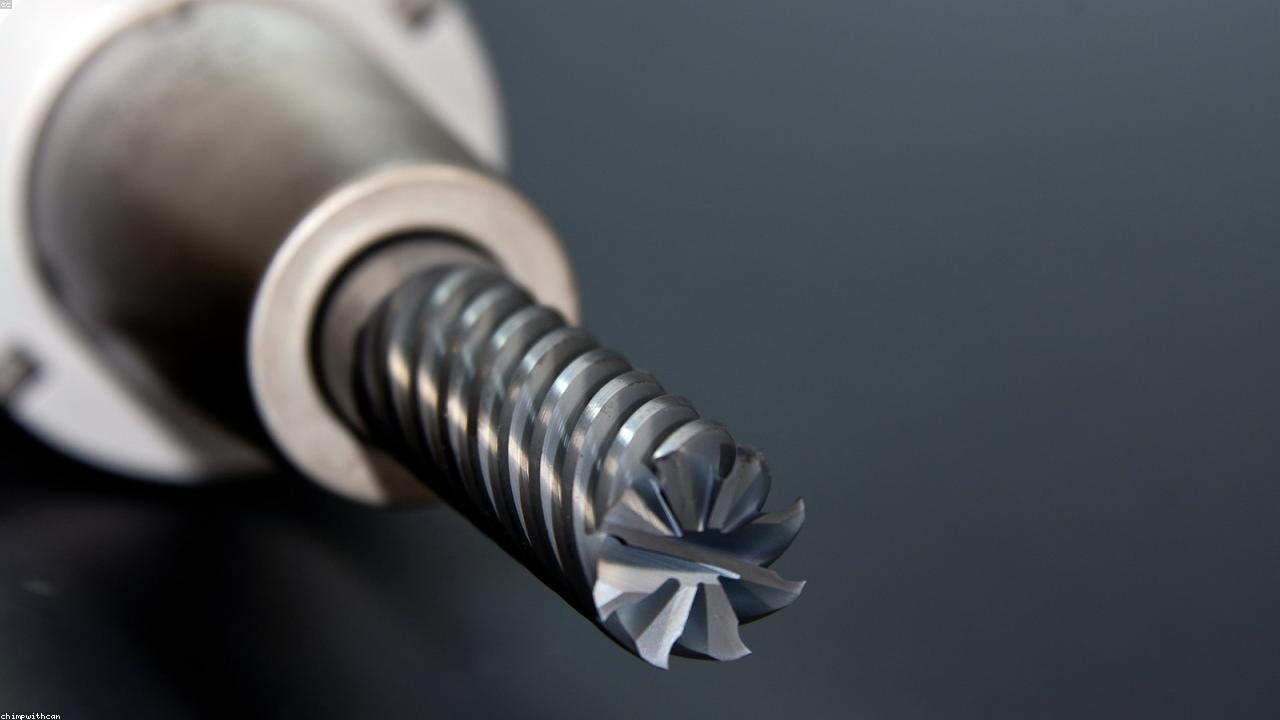
End mill — the rotating cutter with flutes on its sides and end; the default tool for slots, pockets, profiling and most mill work.
Ball nose end mill — an end mill with a rounded tip, used for contoured and 3D surfaces where a flat-bottomed tool would leave ridges.
Face mill — a wide cutter that skims a flat surface true and clean in one pass.
Drill bit — the tool that makes holes. Good holemaking on CNC is a sequence: spot, drill, then ream or bore if the hole must be accurate.
Centre drill — a short, stiff drill used to start a hole accurately so the following drill doesn't wander.
Tap — the tool that cuts internal threads. On CNC, rigid tapping or thread milling is used instead of hand tapping for accuracy and throughput.
Reamer — a tool that lightly enlarges a drilled hole to a precise, smooth finished size.
Boring bar — a single-point tool that enlarges or finishes a hole to exact size and position, correcting hole location a reamer can't.
Insert — a replaceable cutting edge, usually carbide, ceramic or cermet, clamped to a tool body and indexed to a fresh edge when worn. Indexable tooling is the backbone of production turning and many milling cutters.
Flute — the helical groove along a cutter that forms its cutting edge and carries chips away. Flute count is a selection lever: more flutes, stiffer but less chip room.
High-speed steel (HSS) — a tough, lower-cost tool material, still the sensible choice for many drills and taps; carbide replaces it wherever speed and wear dominate.
Carbide — tungsten-carbide tooling: hard, heat-resistant and far faster-cutting than HSS, at higher cost and lower toughness. The default for modern production.
Tool coating — a thin surface layer (TiN, TiAlN, AlCrN, diamond) that lowers friction and wear at the cutting edge and lets tools run hotter and longer.
Toolholder — the interface holding a tool in the spindle: collet chuck, shrink-fit, hydraulic, or a steep-taper (BT/CAT) or HSK system. Runout here is accuracy lost before the tool ever cuts.
Cutting parameters and strategy
Spindle speed — the rotation rate of the spindle or workpiece, in RPM. The machine setting you dial; the value you choose is derived from cutting speed and diameter.
Cutting speed — the speed at which the cutting edge passes the material, in surface feet per minute (SFM) or metres per minute. This is the number you look up by material, then convert to RPM for the diameter being cut.
Feed rate — how fast the tool advances into the work: millimetres or inches per minute on a mill, per revolution on a lathe.
Chip load / feed per tooth — the thickness each cutting edge removes per revolution. The number that ties spindle speed, feed rate and flute count together on a mill.
Depth of cut (axial) — how deeply the tool engages along the spindle axis in one pass. Deep cuts remove stock fast but load the tool and the machine.
Radial engagement / stepover — how widely the tool engages sideways. Keeping radial engagement light is the basis of high-efficiency milling: the tool cuts cool and fast instead of fighting a wide, hot engagement.
Roughing — the early passes that remove bulk material quickly, leaving a small stock allowance for finishing. The goal is material removal rate, not surface.
Finishing — the final passes at light depth and feed that bring the part to size and to its specified surface finish.
Climb vs conventional milling — climb milling cuts with the rotation into the work (better finish and tool life on rigid CNC); conventional milling cuts against it (safer on machines with backlash). CNC almost always runs climb.
High-efficiency milling (HEM) / trochoidal paths — light radial engagement at high speed and feed, letting the tool remove metal fast with low heat and load. The modern default for slotting and pocketing.
High-speed machining (HSM) — a broad term for running higher spindle speeds with light, even cuts to cut fast and keep the tool cool.
Peck drilling — drilling in short steps, retracting regularly to break and clear chips in deep holes.
Ramping — entering material at an angle instead of plunging straight in, protecting the tool's centre from cutting at zero speed.
Constant surface speed (CSS) — the control mode (G96) that keeps cutting speed constant as the diameter changes during facing or turning, by adjusting spindle RPM. Switch it off (G97) when a constant RPM matters more.
Workholding and setup
Workholding — everything that holds the workpiece still during the cut: vises, clamps, chucks, fixtures, pallets. Good workholding is half of any accurate job.
Vise — the shop-floor default workholder: a rigid, bolted-down jaw device that grips parallel stock.
Soft jaws — machinable vise jaws cut to match a specific part shape, giving repeatable, burr-free location run after run.
Fixture — purpose-built workholding that locates and clamps a particular part or part family, usually for production runs.
Jig — a device that locates the part and guides the tool (for example through a drill bushing). More a manual-machining concept; fixtures and pallets dominate CNC.
Tombstone — a multi-sided block, usually on an HMC or pallet, that carries several parts or fixtures at once so the spindle keeps cutting.
Clamp — a generic hold-down — strap, toe, toggle — that presses the part to the table or fixture.
Edge finder — a spring-loaded probe tool used to locate a part's exact edge when teaching work zero.
Tramming — squaring the spindle (or quill) to the table so cuts are perpendicular and surfaces come out flat. A trammed machine is the prerequisite for everything else.
Measurement and quality
Tolerance — the allowable deviation from a nominal dimension. Holding tolerance run after run is the entire commercial point of CNC; a machine's stiffness, the setup and the tool all show up here.
GD&T (geometric dimensioning and tolerancing) — a symbol language that defines form, orientation and position tolerances, not just size. Reading it is how you know what a drawing actually demands.
Datum — a fixed reference point, plane or axis from which measurements and positions are taken.
Runout — how much a rotating feature wobbles off true. Spindle runout, holder runout and part runout each steal accuracy in their own way.
Surface finish (Ra) — the average roughness of a machined surface, in micrometres or microinches. Driven mainly by feed rate, nose radius and tool condition.
CMM (coordinate measuring machine) — a precision measuring machine that probes a part to verify its dimensions against the drawing or CAD model, usually in a controlled environment.
Micrometre / micrometer — the hand gauge of record, reading to 0.001 mm (a micron) or 0.0001 in (a tenth), for outside, inside or depth sizes.
Caliper — the quick, general-purpose measuring tool (vernier, dial or digital) for everyday sizes to a hundredth of a millimetre or thousandth of an inch.
Dial / test indicator — a sensitive gauge for checking runout, tram, and small relative movements.
Bore gauge — a gauge that measures internal diameters accurately, usually read with a micrometer or indicator.
On-machine probing — a touch probe in the spindle that measures the part or setup on the machine itself: setting work zero, checking a critical feature, or feeding a correction back before the next cut.
Accuracy vs repeatability — accuracy is hitting the true commanded position; repeatability is returning to the same position run after run. CNC repeatability is usually better than its absolute accuracy — a distinction that matters when a shop spec sheet quotes one without the other.
Automation and unattended running
Automation — systems that keep machines working without direct operator action: pallet changers, robot tending, bar feeders, and the process maturity to run them unattended.
Lights-out manufacturing — running machines unattended, through breaks, second shift and overnight. It demands proven programs, monitored tool life and reliable chip and coolant handling — automation is as much about trust as about hardware.
Robot tending — a robot (often a cobot) loading and unloading parts into a machine, freeing the operator for setup and inspection.
Cobot — a collaborative robot designed to work safely alongside people, typically without a guarding cage — the common entry point for small-shop automation.
Bar feeder — a device that feeds bar stock into a lathe automatically, so long runs of turned parts run with minimal attention.
Pallet changer / pool — automation that swaps pallets in and out of the machine automatically, keeping the spindle cutting while setups happen off-line.
Machining cell / FMS — a group of machines linked by automation — robots, pallets, common control — working as one system rather than islands.
Safety and shop basics
E-stop — the emergency stop button that immediately cuts power and stops motion. It is the last line of defence, not a habit.
Interlock — a safety device that prevents machine motion while a door is open or a guard is missing.
Guarding — the enclosures, covers and shields that separate people from the cutting zone, chips and coolant. Interlocks are only as good as the habit of keeping guards in place.
Bottom line
A shared vocabulary is what makes a shop floor work: the programmer, the operator, the buyer and the customer all have to mean the same thing by “tolerance,” “feed rate” or “lights-out.” Treat this glossary as the reference the rest of the site links to — and if a term is doing your head in, the machine types, the process from CAD to part, and the parameters behind every cut are covered in their own guides.
This reference is part of the CNC Media guides library — practical, plain-language content for engineers and shop managers, kept current as the trade evolves.